

Single-Door Vs. Double-Door Electrical Enclosures: How To Select The Right Configuration
Oct 20, 2026
Leave a message
A single-door enclosure provides one continuous front opening, making it practical for compact cabinets and installations with relatively straightforward component layouts. A double-door enclosure divides the front access into two sections, which can be more suitable for wider cabinets containing multiple rows of electrical equipment. The right choice depends on the cabinet dimensions, internal layout, installation environment, and required protection level.
What Is the Difference Between Single-Door and Double-Door Electrical Enclosures?
The main difference lies in the front access structure. This affects door movement, component accessibility, and the arrangement of equipment inside the enclosure.
| Comparison Factor | Single-Door Enclosure | Double-Door Enclosure |
|---|---|---|
| Front structure | One main door | Two front doors |
| Typical application | Compact control panels and distribution boxes | Wider control cabinets and larger electrical assemblies |
| Door opening | One door swings outward | Two doors open according to the hinge and locking design |
| Internal layout | Suitable for concentrated component arrangements | Suitable for equipment distributed across a wider mounting area |
| Installation clearance | Requires clearance for the full door swing | Each door has its own swing area |
| Maintenance access | Direct access through one opening | Access can be arranged through one or both doors |
| Design considerations | Door width, mounting space, and opening direction | Door alignment, center closing arrangement, and sealing |
These are general design tendencies rather than absolute rules. A large single-door cabinet may be feasible, while a double-door configuration may also be used for smaller enclosures when the equipment arrangement calls for it.
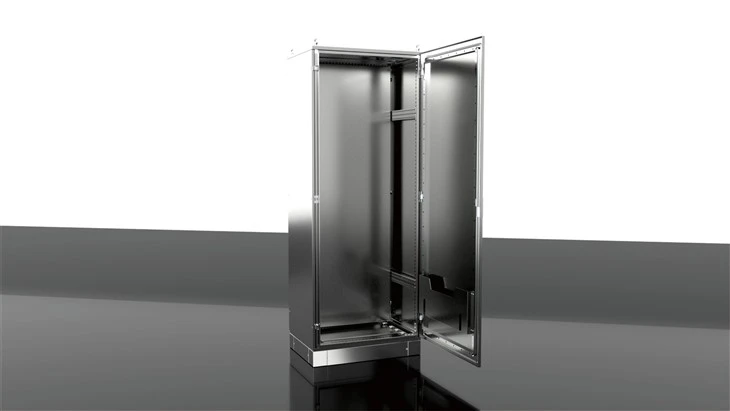

When Should You Choose a Single-Door Electrical Enclosure?
A single-door configuration is often appropriate when the enclosure has a relatively narrow front face and the internal equipment can be installed and serviced through one opening.
For small distribution boxes, machine control panels, and local electrical control units, one door can provide sufficient access to circuit breakers, terminal blocks, relays, and other components. A simpler front structure can also reduce the number of door hardware components required.
When most components are mounted on a single backplate, technicians can access the wiring and mounting positions through one opening. This arrangement is particularly useful when the equipment layout does not require separate access zones.
A single-door enclosure may suit installations where the cabinet width is limited but sufficient clearance is available for the door to swing open. However, the door's actual opening arc must be checked against nearby walls, machines, cable trays, and other cabinets.
Before finalizing the design, verify the opening angle, hinge position, handle location, and clearance for components mounted on the door itself.
When Is a Double-Door Electrical Enclosure More Suitable?
Double-door enclosures are commonly considered for wider cabinets that contain larger electrical assemblies or require access across an extensive mounting area.
Power distribution assemblies, PLC systems, variable-frequency drives (VFDs), and terminal groups may occupy different sections of a cabinet. Two doors can provide access across the wider front without requiring one continuous door panel.
The internal arrangement should still leave sufficient space for wiring ducts, cable bends, component ventilation, and maintenance work.
For a wide cabinet, dividing the front into two doors can make each door narrower than a single full-width panel. This can help with handling and access, although the appropriate door dimensions depend on sheet thickness, reinforcement, hinge capacity, and the overall cabinet design.
Depending on the cabinet layout and locking system, technicians may be able to open one door to access a particular section without opening both doors. This is useful when the design supports separate access zones, but it should not be assumed that every double-door enclosure provides independent access to electrically isolated compartments.
Engineers should confirm whether the doors can operate independently and whether any internal barriers or separate locking arrangements are required.
How Do Installation Space and Maintenance Access Affect the Choice?
Door configuration should be evaluated against the actual installation location, not just the enclosure's external dimensions.
Consider these three factors:
Front clearance: Measure the available distance between the cabinet and nearby equipment. Both configurations need room for the doors to swing outward.
Working access: Allow enough space for technicians to inspect components, use tools, remove mounting plates where applicable, and replace equipment.
Adjacent installations: In a row of cabinets, check whether open doors will interfere with neighboring units or obstruct an aisle.
A double-door design does not automatically require less total clearance. Its advantage is that the opening can be divided between two doors, which may improve access arrangements depending on the available space.
For cabinets installed in narrow service corridors, a layout drawing showing the door swing and maintenance area can help identify potential interference before manufacturing.
Does Door Configuration Affect IP Protection?
Both single-door and double-door electrical enclosures can be designed for specified ingress protection ratings. The number of doors alone does not determine whether an enclosure meets a particular IP rating.
Protection performance depends on several construction details:
| Design Element | What to Check |
|---|---|
| Door gasket | Continuous sealing path and suitable compression |
| Door alignment | Consistent contact between the door and enclosure body |
| Hinges and locks | Correct positioning and sufficient closing force |
| Cable entries | Suitable gland plates, cable glands, and sealing arrangements |
| Cutouts | Proper sealing around displays, switches, and other installed components |
| Installation conditions | Correct mounting and compliance with the intended operating environment |
For example, an IP66 wall-mounted enclosure may use a molded edge structure, a sealing gasket, and sealed cable-entry interfaces. A floor-standing cabinet with an IP55 rating has different protection requirements and must be assessed against its intended environment.
Always confirm the required IP rating and the configuration-specific test or certification documentation. Do not assume that a single-door enclosure has a higher protection level than a double-door model, or vice versa.
What Should You Confirm Before Ordering?
Once the door configuration has been selected, the following specifications should be reviewed before requesting a quotation.
Cabinet dimensions: Confirm the external width, height, depth, available installation space, and required internal mounting area.
Material and thickness: Specify the required steel, stainless steel, or aluminum grade, together with the body, door, and mounting plate thicknesses.
Internal component layout: Provide the positions and dimensions of circuit breakers, PLCs, VFDs, terminal blocks, and other major components.
Door hardware: Confirm the hinge side, opening angle, lock type, handles, and whether the doors need to open independently.
Cable entry and cutouts: Indicate cable entry locations, gland sizes, control-panel openings, and any ventilation requirements.
Surface finish and protection: Specify the coating or surface treatment, operating environment, and required IP rating.
Production requirements: Provide drawings, tolerances, quantity, labeling details, and any assembly requirements.
Sharing these details early helps the enclosure manufacturer evaluate the structure before fabrication and reduces the risk of changes after the cabinet has been produced.
Why Choose Prota for Electrical Enclosure Manufacturing?
Anji Huacheng Electrics Co., Ltd., operating under the Prota brand, provides metal enclosure manufacturing and customization for industrial and OEM applications. Its engineering support covers enclosure design, material selection, sheet metal fabrication, and assembly.
Prota's manufacturing processes include laser cutting, CNC bending, welding, and powder coating. These processes support the production of enclosure bodies, door panels, mounting structures, and customized openings according to approved drawings and project requirements.
For single-door and double-door projects, the configuration can be evaluated alongside cabinet dimensions, internal component positions, hinge and lock arrangements, cable entry, and required protection levels. Material inspection, dimensional verification, and surface quality checks are also part of the company's stated quality-control process.
Customers can provide 2D drawings, 3D models, or technical specifications for review. This allows the door arrangement and enclosure structure to be considered together with installation conditions and maintenance access rather than selected by cabinet size alone.
Send Inquiry